


15 Tech Brands Owned By Google
15 Tech Brands Owned By Google

Marc MagriniSun, October 11, 2026 at 1:30 AM UTC
0
Gary Hershorn/Getty Images (Gary Hershorn/Getty Images)While search drove Google's astronomic rise, the acquisitions it's made over the years have helped it stay among the biggest corporations in the world.
These days, if you know the name of any brand focused on technology, it's probably either a major corporate entity or under the umbrella of one. The real owners behind the world's biggest tech companies have been pulling countless people and products into their workforce in one way or another — and that's especially the case with Google and its parent company, Alphabet. In fact, there are many different brands under Alphabet's thumb, which (for the purposes of this article) also counts as being owned by Google. If you include brands that have gone defunct, the full list is very long, too — these acquisitions have been occurring for decades, after all.
A few product lines are very obviously owned by Google, such as the Google Pixel or Chromebook, but these were started by the company, and there's very little question as to their original and continued ownership. Things get a bit trickier when you look at the backstory for the brands included on this list, as they were either acquired or eventually joined under the Alphabet banner. That's what we'll be focusing on here. There's a good chance that you might not have known some of these were even owned by Google in the first place.
Read more: 5 Air Conditioner Brands Owned By Bosch
Android
Justin Sullivan/Getty Images
As Android has evolved over the years, it's become an extremely competitive mobile operating system. It managed that success with Google behind it, which is why just about every handheld device running it comes with Google apps preinstalled. It's also why the Play Store is the de facto source of Android apps in general, with the OS making efforts to keep it that way. However, the Android brand wasn't actually conceived of by Google initially.
The birth of Android — as a company, not as an operating system — came in 2003 from a small group of Californian entrepreneurs. They always planned to work with smartphones to some degree, but nothing solid had formed by the time Google took over just two years later. It wouldn't be until 2008 when the first Android version released to the public. Since then, the operating system has been vital to Google, even now, long after the company launched its own in-house ChromeOS.
AppSheet
Stockinq/Shutterstock
AppSheet is a platform that's meant to help people develop their own applications. Today, it predictably takes advantage of Google's Gemini artificial intelligence, with a focus on helping developers with a lack of any coding experience or knowledge. It's even presented under the company's name, similarly to Google Docs and Google Slides. However, the platform existed for eight years independently, and depending on who you ask, it has since become nothing more than a shell of what it once was.
The controversy here comes from the original founder of AppSheet. Praveen Seshadri sounded the alarm after Google bought his startup in early 2020, citing problems with management and overly lengthy development processes. It's somewhat ironic, considering the platform's intentions to make such processes easier for tech enthusiasts on a consumer level. Still, despite the concerns, AppSheet continues to be a major part of Google's Workspace, allowing it to stand alongside noteworthy services from the company like Gmail and Drive.
Cameyo
Cameyo is a brand focused on virtualization, seeking to allow desktop-based applications to run in web browsers. The benefits the service provides are especially relevant for Google's aforementioned ChromeOS, as it can allow users to gain access to many different Windows apps without the need of virtual desktop environments. It also has a great deal of focus on security, since ChromeOS has supposedly never suffered from virus or ransomware attacks out in the wild.
Cameyo took shape in 2010, and its purpose hasn't changed much since then. Initially, it teamed up with Google to integrate its services into the Chromebooks, before getting acquired in 2024, under a year later. Today, that integration has become much deeper, with Cameyo also including support for Google's Gemini AI and Chrome Enterprise. This is one of Google's most recent acquisitions, so it seems like there are still plenty of developments to come from this partnership.
DeepMind
Dan Kitwood/Getty Images
As the name implies, DeepMind is all about AI. Today, it's entirely part of Google's repertoire, taking on the company name and going all-in on its Gemini intelligence. This shouldn't be a surprise considering the recent AI boom, although DeepMind itself isn't competing very well in that space. But it might come as a shock that its acquisition actually happened a long time ago, well before people were having serious discussions on how doomed humans are if AI gets too smart.
DeepMind started out in 2010 and was taken over by Google just four years later. However, Google also had its own AI-powered technology project at the time, known as Google Brain. The two sides were only really brought together in 2023, leading to DeepMind's current foothold in generative AI. Interestingly, the company also made its own ethics unit in 2017, although the question of whether generative AI itself is ethical continues to drive heated arguments.
Firebase
Stockinq/Shutterstock
Firebase isn't too far away from AppSheet in its intentions to make app development simpler and more accessible, though it focuses more on the actual coding process. It still pushes hard for an AI angle, though, highlighting generative agents as part of its app-building fundamentals. As you might expect, this wasn't always the case. Firebase's origins actually date back to the early 2010s, though its independence ended when Google acquired it in 2014.
In recent years, Firebase has actually been a source of controversy for Google. The parent company had reportedly been using the platform to collect data from users even after they opted out of its collection policy, which led to Google being forced to pay $425 million in damages. However, this hasn't led to the company winding down on its support for the platform, and that's probably a good thing, given the fact that countless apps rely on Firebase to function properly.
Fitbit
Rohane Hamilton/Shutterstock
Although Google has been making strides with its Pixel Watch lineup, that hasn't stopped it from continuing to develop the Fitbit lineup. These health-focused smartwatches are made to help people track their wellness and follow through with their fitness. Newer models have brought even more focus to this purpose by coming without a screen, as we mentioned in our Fitbit Air review. It seems as though Fitbit is basically Google's budget-friendly offering for those who don't need a full dedicated smartwatch.
Fitbit began all the way back in 2007, starting out as a series of personal trackers you could clip onto your clothing. Eventually, the watch-like form factor would be adopted, and actual watch functionality would come in 2017. All things considered, the company ran for quite a long time independently. Google's acquisition only took shape in 2021, and that was actually what led to the first Pixel Watch coming out just one year later.
Intrinsic
Smith Collection/gado/Getty Images
Intrinsic is in a rather unique situation, but it has some interesting parallels with DeepMind. Unlike DeepMind, Intrinsic wasn't "acquired" by Google at all; Alphabet formed it back in 2021, which should technically be enough to keep it out of this list's spotlights. However, the company actually ended up joining Google in full at the end of February 2026. It went from an experimental sub-company to an integral part of Google's efforts in AI development.
Although DeepMind existed long before the AI boom of the modern era, Intrinsic was practically born right into it. However, its efforts have also been targeted more toward physical outlets. Robotics are a major part of its mission statement, rather than the generative and large language model (LLM) AI services flooding the internet today. Again, it's an interesting coincidence of timing, especially with DeepMind's acquisition coming so long before Intrinsic's founding.
Advertisement
Kaggle
Sharaf Maksumov/Shutterstock
Kaggle is yet another brand focused entirely on AI today, providing resources to measure and test the performance of various models. Its case is a bit closer to Firebase, as it wasn't always so AI-focused. 2010 was when Kaggle was created, with more of a general data science focus. However, that focus would expand to machine learning pretty quickly, and the company would be acquired by Google in 2017.
Also like Firebase, Kaggle came under fire for concerns over its data collection practices. Although this hasn't led to similar lawsuits, it's caused a great deal of controversy in the medical community, with the faces of children and celebrities being used in questionable ways. Despite this, other major tech brands give a great deal of attention to Kaggle since it presents competitions for those groups to pit their AI models against each other. Whether you agree with Kaggle's efforts or not, there's no question that the current world of technology is the perfect opportunity for it to thrive in — especially with Google backing it up.
Mandiant
T. Schneider/Shutterstock
Mandiant is unlike most of the other brands in this list. Instead of providing AI solutions or app development, it acts as a consultant for cybersecurity issues. That makes it particularly important not just for Google, but for the U.S. government. The company was even a primary source of expert knowledge in 2026, when an alleged North Korean hack of U.S. companies affected vital software.
Google wasn't actually the first company to buy Mandiant. While it was independently founded under the name Red Cliff Consulting in 2004, Mandiant would be acquired by FireEye in 2013. However, FireEye later sold ownership of its products and brands (as well as its name) in the 2020s, and it was during that period that Google took over Mandiant, in 2022. Today, the firm is integrated into Google's Cloud services and allows anyone to contact experts for the sake of resolving incidents and testing out new cybersecurity solutions.
Photomath
PJ McDonnell/Shutterstock
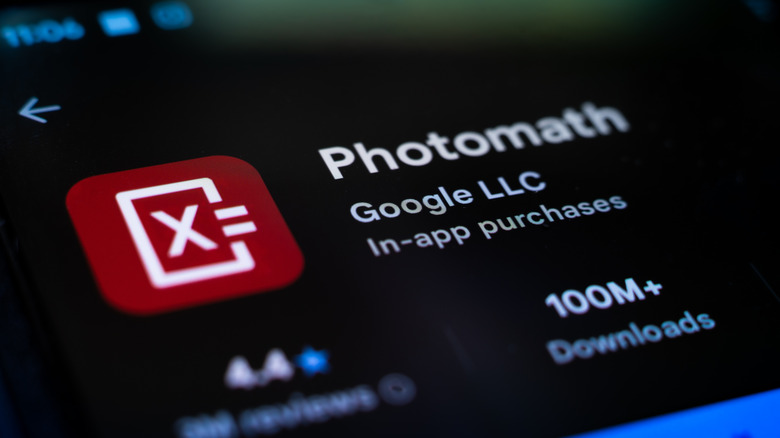
Photomath is an application with a very specific focus, and it's pretty easy to guess what that focus is from the name alone. You take a photo of a math problem, and the app tells you how to solve it with step-by-step instructions. There really isn't much more to it than that, but it seems to be fairly effective, given the app has over 100 million downloads on the Play Store. Of course, this process involves AI, which should probably be expected for a modern app with automatic image-detection problem solving.
Back in 2014, Photomath was created by a company that dove deep into text recognition. It received plenty of attention and investments in the years that followed, with Google eventually taking it over completely in 2023. It's hard to say if that acquisition is what influenced the app's current use of AI, but it always had some form of automation when it came to recognizing and solving math equations. In a way, you could argue that Photomath was simply ahead of its time — especially with other AI models attempting to make major strides in mathematics, too.
reCAPTCHA
Rokas Tenys/Shutterstock
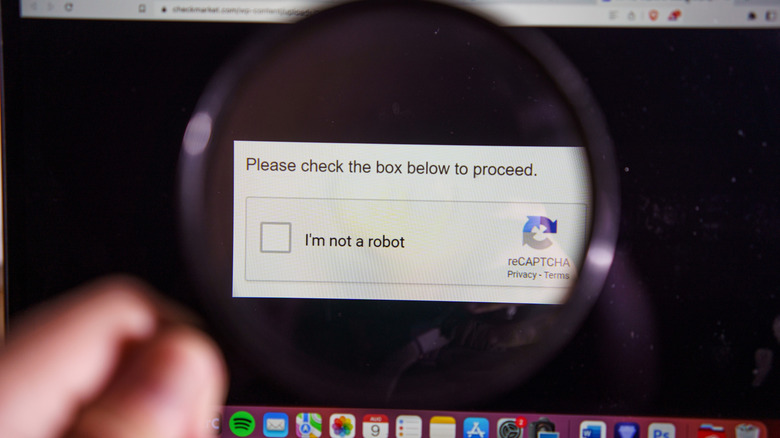
If you've browsed the internet for any significant amount of time, you've almost certainly bumped into reCAPTCHA. From its outset in 2007, the service was designed to fight against automated bots, freeing up traffic for human users. Google took it over in 2009, and it's now practically an accepted part of basic internet browsing. It even comes up in Google's own search engine when it detects strange activity from your device, trying to confirm that you aren't making automated searches.
Today, reCAPTCHA is even more prevalent. Efforts have been made to lessen its impact on everyday browsing, but the recent AI boom has led to many different websites making full use of its services. As CEOs claim that much of the internet is dead, the concern of automated bots scraping data and using it to train AI is higher than ever. Those who use the internet every day are starting to see reCAPTCHA more and more, and it's unfortunately pretty necessary just to keep sites usable for the average person.
Siemplify
Koshiro K/Shutterstock
Mandiant wasn't the only cybersecurity company Google acquired in 2022. The corporation also got its hands on Siemplify that same year, with the brand having "now part of Google Cloud" practically affixed to its name today. Siemplify originally took shape in 2015, providing solutions for security orchestration, automation, and response (also known as SOAR). Google's takeover was made with the idea that those solutions could be integrated into its own cloud security.
Despite the overlap between Siemplify and Mandiant, the former isn't anywhere close to the latter's notability. It's been getting more deeply integrated into Google's systems, but it hasn't gotten attention from major government entities. Of course, both sides have different focuses, much like Firebase and Kaggle or Deepmind and Intrinsic. It's an another example of how Google's acquisitions aren't as redundant as they might seem, instead allowing the company to cover as many bases as it can for different areas of tech.
Waze
Allard1/Getty Images
Created all the way back in 2008, Waze is focused on transportation — particularly when issues arise with the normal routes of it. By crowdsourcing data from drivers, the app helps people figure out alternate routes and plan ahead for traffic jams. 2013 was when Google acquired it for its own portfolio, despite Google Maps having already existed since 2005. And yet, despite this apparent overlap, Waze has continued to offer its own dedicated app separately from Google Maps.
When comparing Waze vs. Google Maps, the former has an edge with car-based navigation. It has a focus on drivers helping drivers, after all, so it's able to specialize the information it gives to users. Of course, this leads back into the aforementioned "cover its bases" idea, with Maps still showing more capabilities when it comes to gathering information from the destinations themselves. There are valid reasons to use both apps in tandem, which is probably why Google hasn't completely gutted the brand to focus solely on its in-house offerings.
Wiz
Poetra.RH/Shutterstock
Wiz might fit a bit more closely with the modern acquisitions you'd expect from a major tech company today. Founded in 2020, its focus is on AI and cybersecurity, and the need for work-from-home productivity was the perfect environment for it to thrive in. That's allowed Wiz to have a foothold not just in the tech industry, but also in major Fortune 100 companies like Fox, BMW, and Chipotle. It also happens to be the most recent acquisition on this list, having joined Google in March of this year.
Security is the primary focus of Wiz, but it's been going all-in on AI in recent days, especially since the Google acquisition. The company has even been using it to find security flaws in technology, and it's been pooling resources with other firms to further strengthen its flaw-finding and vulnerability-patching efforts. Wiz's focus on AI wasn't born from Google's acquisition, but it certainly helps the latter's development of things like Gemini.
YouTube
miss.cabul/Shutterstock
The final acquisition on this list is perhaps the most famous. YouTube's humble beginnings as a video-sharing platform in 2005 led to its very quick acquisition in 2006, and it's been a vital part of Google's brands since then. And that led to quite a few controversies as Google attempted to integrate it even deeper into its ecosystem. That accounts for the Google Plus comment issues in 2013 and today's YouTube TV users missing out on major channels due to Disney disagreements behind the scenes.
Regardless of those controversies, YouTube remains as the most popular website in the entire internet, save for Google itself. It and Android might be more noteworthy than any other Google-owned brand that isn't named after the search engine. And they're most likely a major part of why the company is currently the most profitable in the world. Granted, that hasn't stopped YouTube from ramping up its efforts to fight against ad blockers, but it's still a prime example of why Google has made all of these acquisitions in the first place.
Want the latest in tech and auto trends? Subscribe to our free newsletter for the latest headlines, expert guides, and how-to tips, one email at a time. You can also add us as a preferred search source on Google.
Read the original article on SlashGear.
Source: “AOL Money”
